

People who have experienced trauma often notice that their body no longer feels natural or safe. It carries tension. It reacts faster than words can follow. Sometimes it remains alert long after the danger has passed.
For many people, sports and exercise become more than a hobby. They become a way to manage tension, sleep better, release energy, or feel strong again. That can be valuable. But there is another side to it as well.
Sometimes you move to recover. Sometimes you move so you do not have to feel. That is why sports and PTSD deserve an honest conversation.
Why sports and exercise can help with PTSD#
Research shows that regular physical activity can help reduce PTSD symptoms. Exercise supports sleep quality, improves mood, contributes to stress regulation, and builds fitness, energy, and self-confidence. It also creates space to release tension and develop body awareness. Two things that are often disrupted by trauma.
Movement affects stress hormones, neuroplasticity, and the autonomic nervous system. But beyond the science, many people experience something simpler: after moving, there is more space in both mind and body.
Helping the body out of alarm mode#
With PTSD and moral injury, the system is often stuck in readiness. Breathing stays shallow, muscles remain tense, sleep becomes difficult, startle responses are intense, and rest itself can paradoxically feel unsafe. That is not a character flaw. It is a nervous system that has learned to stay vigilant.
Rhythmic and regular movement can help the system relearn how to shift between activation and recovery. This is exactly what Porges’ polyvagal theory describes: a nervous system capable of moving between mobilization and calm instead of getting trapped in a single state.
Which forms of exercise can help?#
Not every sport works the same way. Do not choose what sounds tough. Choose what feels regulating.
Walking#
Accessible, rhythmic, and easy to combine with nature and daylight.
Running#
Can discharge tension and create mental space when done in moderation. For some people, the first ten minutes feel uncomfortable and the rest feels relieving. For others, shorter and more frequent runs work better than long sessions.
Strength training#
Helps build stability, body confidence, and awareness of personal strength. Especially valuable for people who experience the body as something that happens to them instead of something that belongs to them.
Boxing#
Can help with sensing boundaries, regulating force, and staying present under activation. For some people it works extremely well. For others, especially those with a history of violence, it can become dysregulating. Listen carefully to what your body tells you during the first lessons.
Yoga or gentle mobility work#
Supports breathing, body awareness, and the ability to slow down.
Swimming#
For some people highly regulating because of rhythm, breath control, and the pressure of water on the body.
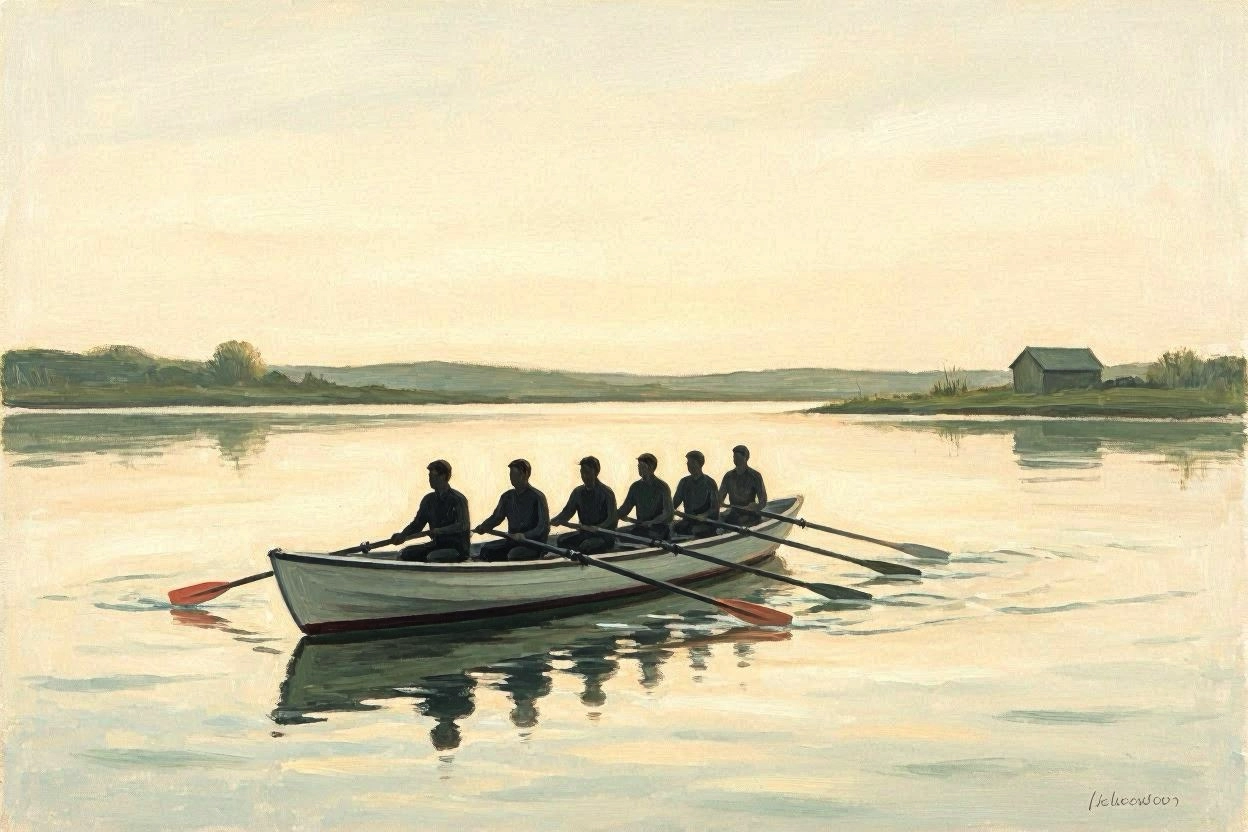
Traditional rowing: rhythm and connection#
Traditional rowing can be especially valuable for people with PTSD. The rhythm of the strokes, the water, the shared cadence, and the physical effort make it intense yet regulating at the same time. Together, you move the boat forward. That creates not only movement, but also connection.
Within that shared rhythm, the nervous system can learn that strength is not the same thing as danger.
When sports become avoidance#
This is the shadow side.
I have personally pushed myself physically far beyond what was healthy. There were periods when I did not exercise to recover, but to exhaust myself completely. If I became tired enough, I hoped to sleep better, dream less, and feel less.
As long as I kept training, I could stay away from what lived underneath the surface. But as soon as I stopped, it returned.
That pattern is common. Sports and exercise can temporarily numb, suppress, or create a sense of control. At that point movement stops being a bridge and becomes a wall.
You often recognize the pattern through several signs: constantly needing to train harder for the same effect, feeling restless on rest days, guilt when skipping training, only feeling calm after complete exhaustion, ignoring injuries, avoiding emotions through exercise, or building your entire identity around performance. One signal alone is not necessarily alarming. Several together deserve an honest look.
When exercise backfires: cortisol and recovery#
Intense exercise temporarily raises cortisol and other stress responses. That is normal. The body releases energy to handle physical effort. Problems usually arise not from one hard workout, but when high strain accumulates without enough sleep, rest, and recovery.
For people with PTSD, this matters even more. A nervous system already under pressure often benefits more from measured consistency than from constant overload. If you notice that exercise worsens your sleep, increases irritability, or leaves exhaustion lingering for days, the answer is often not more training, but smarter pacing.
Moderate is often stronger than extreme#
Heavy training is not inherently wrong, but more is not always better. Especially with an overloaded stress system, steady and manageable movement often works better than extreme peaks. Consistent movement beats heroic exhaustion.
Sports as part of treatment#
Exercise is also used within trauma treatment itself. Some programs combine therapy with physical training because the body actively participates in recovery.
A Dutch example is PsyTrec in Bilthoven, a center offering intensive trauma treatment in which EMDR and imaginal exposure are combined with physical exercise and psychoeducation. The idea behind this approach is that activating the nervous system through movement around therapy sessions may support processing. Research from PsyTrec shows reasonable treatment outcomes, including for more complex PTSD.
At the same time, experiences from former patients online are mixed. For some people the intensive short-term approach worked very well. Others experienced the pace as too high or missed sufficient aftercare. That does not mean the approach is bad. It reflects something true for many intensive programs: what feels liberating for one person may feel overwhelming for another. What works depends on where you are in your process, the support around you, and how much intensity your nervous system can handle at that moment.
The important distinction remains: sports and exercise do not replace therapy, but they can support it.
What does scientific research say?#
There is now a substantial amount of research on exercise and PTSD. The overall direction is positive: movement can reduce symptoms and support recovery for many people. Systematic reviews and meta-analyses show that regular physical activity may contribute to reduced PTSD symptoms, improved sleep, less anxiety and depression, higher quality of life, greater body confidence, and better stress regulation.
Combinations of cardio, strength training, and body-aware practices such as yoga appear particularly beneficial. Group sports may also provide additional value through connection and motivation.
An important nuance remains: movement is often a powerful building block, but not always a replacement for trauma-focused therapy.
Dutch initiatives and examples#
The Netherlands also has initiatives where movement and recovery come together. There are sports activities and meetings through the BNMO, rowing and outdoor activities for veterans and people with PTSD, and local peer-support projects centered around exercising together. It shows something important: you do not have to do this alone.
How do you choose wisely?#
Do not only ask what is effective. Also ask:
Does this make me feel safer or more driven? Does this give me energy or drain everything from me? Am I actually present while moving? Does this support recovery or avoidance? Does this fit my current capacity?
These are not questions with right or wrong answers. They are questions that provide direction.
Start small#
You do not need to become an elite athlete. Ten minutes of walking, light strength training, cycling outdoors, exercising together with others, regular movement routines, stretching, and breathing are already meaningful building blocks. Recovery is often found in repetition, not heroics.
Further reading#
- Trauma and the Body
- Sleeping With a Vigilant Nervous System
- Daily Rhythm and PTSD
- Cortisol and PTSD
- Porges’ Polyvagal Theory
- Silence and PTSD
- Post-Traumatic Growth
Conclusion: moving in order to stay present#
Sports and exercise can become powerful allies in trauma recovery. They can improve sleep, regulate tension, restore strength, and rebuild trust in the body.
But sports are not a miracle cure. Sometimes they also become a way to avoid pain. The difference is not only in the training itself, but in awareness.
Not moving in order to disappear.
But moving in order to be present.
Sources and scientific publications#
- Rosenbaum, S. et al. (2015). Physical activity interventions for PTSD: systematic review and meta-analysis
- Björkman, F. et al. (2022). Physical Exercise as Treatment for PTSD: systematic review and meta-analysis
- Jadhakhan, F. et al. (2022). Exercise interventions for PTSD symptoms
- Martinez-Calderon, J. et al. (2024). Exercise therapy and quality of life in PTSD
- Yuan, Y. et al. (2025). Physical activity for PTSD, anxiety, depression and sleep: meta-analysis
- Reis, A. et al. (2022). Exercise interventions for military veterans with PTSD
- Powers, M.B. et al. (2015). Exercise augmentation of exposure therapy
Questions?#
Do you recognize this in yourself or in your work with others? Feel free to reach out through the contact form.